Why Most Hairstylists Are Undercharging — And What to Do About It
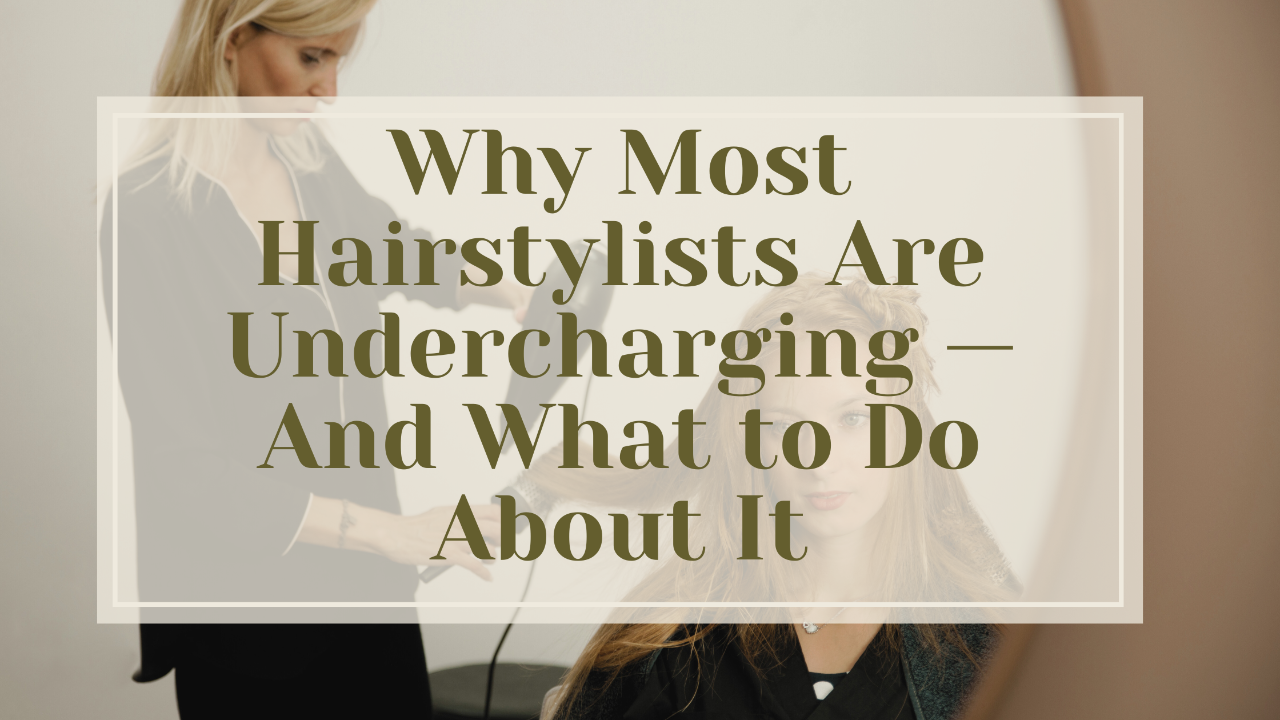
If you're a hairstylist who is fully booked, working hard, doing everything you're supposed to do — and still feeling financially stressed at the end of every month — I want you to read this carefully.
Because the problem probably isn't that you're bad with money. It's not that you're not working hard enough. And it's almost certainly not that your market won't support higher prices.
The problem is that you're undercharging. And you've probably been doing it for longer than you realize.
I know, because I did it for years. And nobody told me. So let me tell you now.
Being fully booked at the wrong price isn't success. It's just a very convincing version of struggle.
Why stylists undercharge — and it's not what you think
Most hairstylists don't undercharge because they're naive or careless. They undercharge because they were never taught how to price correctly in the first place.
Cosmetology school teaches you technique. It doesn't teach you business. So most of us learned to price the same way — we looked at what other stylists in our area were charging and stayed close to that number. It felt safe. It felt normal. It felt like what you were supposed to do.
But here's the problem: if everyone is pricing based on what everyone else is charging, and nobody has actually sat down and calculated what they need to earn to build a sustainable life — then you end up with an entire industry of talented professionals who are collectively undervaluing themselves.
And that's exactly what's happened.
The three fears that keep stylists stuck at the wrong price:
- Fear of losing clients. "If I raise my prices, they'll leave." Some will. But most won't — and the ones who leave are often the most draining clients in your book.
- Fear of judgment. "People will think I'm getting too big for myself." Charging what you're worth is not arrogance. It's math.
- Fear of the conversation. "I don't know how to tell them." This one is real — and it's a problem we can actually solve with the right language and approach.
All three of these fears are understandable. None of them are reasons to stay underpaid.
What undercharging actually costs you
The financial piece is obvious — you earn less than you should for the skill and time you're giving. But the costs go well beyond your bank account.
It costs you physically. When your prices are too low, the only way to increase your income is to see more clients. More clients means more hours on your feet, more repetitive strain, less recovery time. Your body absorbs the difference between what you charge and what you should charge. Over time, that debt compounds.
It costs you energetically. There is a particular kind of resentment that builds when you feel like you're giving more than you're getting. It doesn't always look like anger — sometimes it looks like dread. The Sunday night feeling before a Monday of back-to-back clients. The exhaustion that doesn't go away after a day off. The slow erosion of the thing that made you love this work. That's not a character flaw. It's information.
It costs you your longevity. The stylists who are still behind the chair at 50 and 60, doing work they love — they figured this out. They raised their prices, worked fewer clients at higher rates, and protected their energy. The stylists who burned out at 35 and 40? A lot of them were undercharging the entire time they thought they were building a career.
Raising your prices isn't greedy. It's the thing that makes it possible to still love this work in ten years.
How to know if you're undercharging
Not sure if this applies to you? Sit with these honestly:
- Are you fully booked — and still worried about money at the end of the month?
- Do you feel like you can never afford to take a day off or call in sick?
- Have you not raised your prices in over a year — or ever?
- Do you feel resentful of clients who book your most time-intensive services?
- Do you work through lunch, skip breaks, and squeeze in extra clients regularly?
If you checked even two of those — this is for you.
How to actually raise your prices — without the panic
Step 1: Know your real number. Before you can set the right price, you need to know what you actually need to earn. Not what would be nice — what you genuinely need to cover your expenses, pay yourself a real salary, save, invest, and have a life. Most stylists have never done this math. Do it.
Step 2: Raise gradually if you need to. You don't have to double your prices overnight. A meaningful raise done consistently is more sustainable than a dramatic jump. The key is that you actually do it.
Step 3: Stop announcing, start implementing. You don't owe your clients a lengthy explanation. A simple, warm message is enough: "Starting [date], my service prices will be updating. I'm so grateful for your continued support and look forward to seeing you." That's it. No apology. No discount. Just do it.
Step 4: Let the right clients self-select. Some will leave. That's okay — it's often a gift. The space they leave opens room for clients who value what you offer at the rate you deserve.
The mindset shift that makes all of this possible
Here's the truth underneath all of it: your prices are not just about money. They're a statement about how you see yourself and what you believe you deserve.
When you undercharge, you're communicating — to your clients, to the market, and to yourself — that your time and skill are worth less than they are. That message compounds. It shapes how clients treat you, how you treat yourself, and how you feel about the work.
Raising your prices is, in a very real sense, an act of self-respect. It's saying: I know what this costs me to give. I know what it's worth. And I'm going to charge accordingly.
That shift doesn't happen overnight. But it starts with a decision. And the decision starts with awareness.
If you're reading this — you already have that awareness. That's the hardest part.
Your prices are a statement about how you see yourself and what you believe you deserve.
Jennifer Alden is a hairstylist and educator with over 13 years of experience. She specializes in clean, ammonia-free color and razor cutting, and teaches other stylists how to build sustainable, profitable businesses through her education brand, The Holistic Hairstylist.