Understanding Tonality: How to Read Underlying Pigment and Communicate Color to Your Clients
One of the biggest gaps I see in newer stylists — and honestly even some experienced ones — isn't technical skill. It's the ability to understand what's happening inside the hair and then translate that into language a client can actually understand and trust.
Tonality is at the heart of all of it. If you can master how to read underlying pigment, predict how hair will behave during a lift, and communicate that confidently to your client, you will set yourself apart in a major way. Let's break it all down.
What Is Underlying Pigment — and Why Does It Matter?
Every single head of hair has underlying pigment (also called contributing pigment) sitting inside the cortex. These are the natural warm tones — red, orange, and yellow — that exist at every level of the hair's natural depth.
When you lighten hair, you are not removing color — you are lifting away the natural melanin and exposing these underlying pigments. If you don't account for them in your formulation and toning process, the result is brassiness, warmth, or an off-tone that your client didn't ask for.
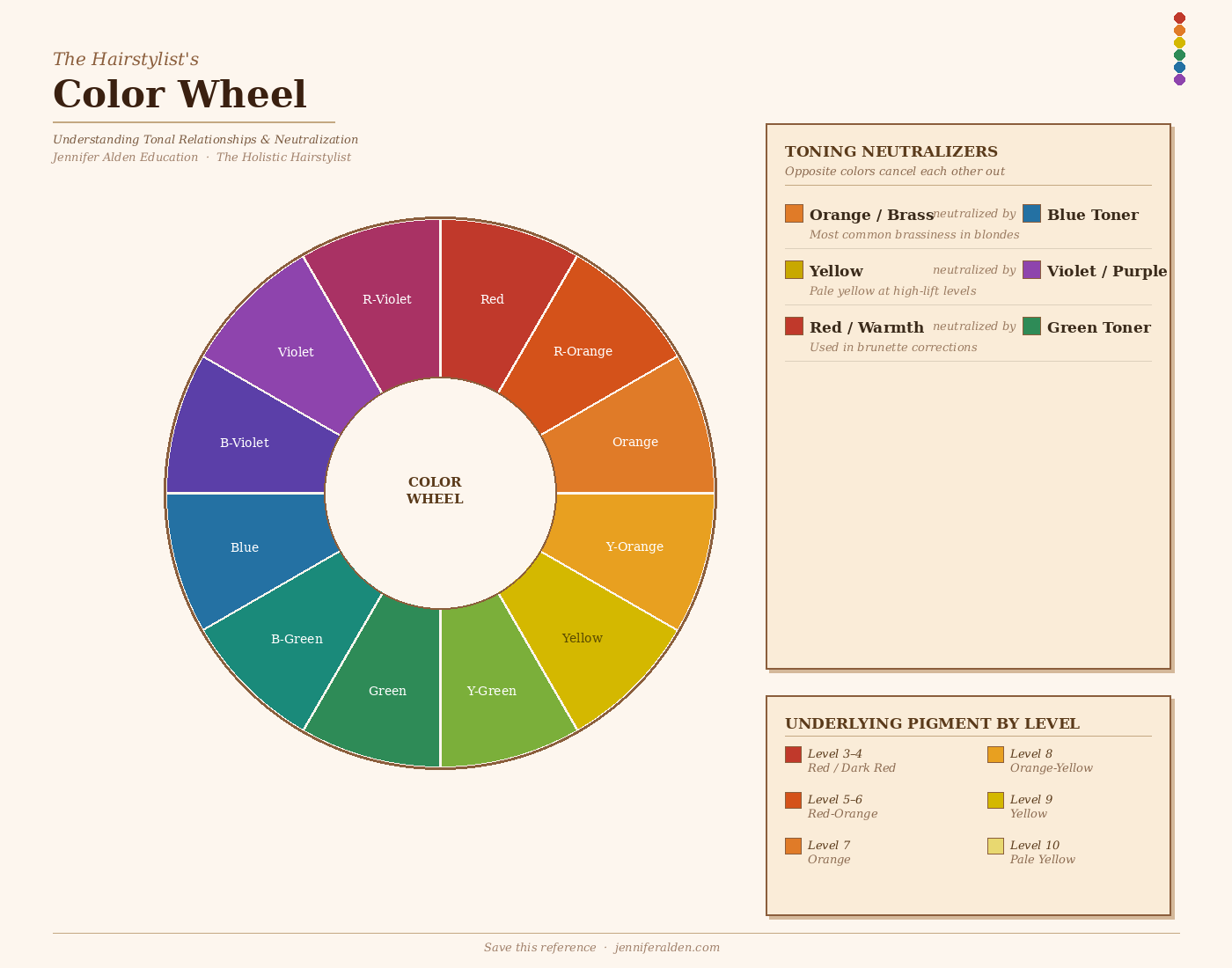
Here's your underlying pigment chart to memorize:
- Level 3–4: Red / Dark Red
- Level 5–6: Red-Orange
- Level 7: Orange
- Level 8: Orange-Yellow
- Level 9: Yellow
- Level 10: Pale Yellow
The Color Wheel Is Your Best Friend
Toning is nothing more than applied color theory. To neutralize an unwanted tone, you use its complement — the color directly opposite it on the color wheel:
- Orange/Brass → neutralized by Blue
- Yellow → neutralized by Violet/Purple
- Red → neutralized by Green
This is why blue-based toners and shampoos knock out brassiness, and why violet-based products work on yellow tones. Once you understand this, you can look at any head of hair and immediately know which direction to take your toner.
Important note: toning isn't always about neutralizing. Sometimes you WANT to enhance warmth — a honey blonde, a warm balayage, a rich copper. Ask yourself before every formula: "What am I neutralizing — and what am I enhancing?"
How to Predict the Outcome Before You Mix
Before you ever open a tube, assess these five things:
- Identify the natural level
- Identify any existing artificial color
- Map the underlying pigment at the target level
- Plan your toner BEFORE you lighten — not after
- Assess porosity — porous hair grabs toner fast
The Art of Client Communication
Script for explaining underlying pigment during consultation: "Your hair naturally holds onto warmth — it's actually a sign of really healthy, strong hair! What that means for us today is that we're going to tone to neutralize that warmth. You'll leave with the color we're going for, but as the weeks go on you might notice a little golden warmth peek back through. That's completely normal, and we can always do a quick gloss refresh to keep it looking fresh."
Script when a client comes back brassy: "I can see some warmth coming through — totally normal with your natural underlying pigment. Your toner has faded and your natural warmth is peeking through. Let's talk about what we can do today and what you can do at home to extend your results."
Script for recommending a toning gloss: "Think of your toner like a filter on a photo. Over time it fades a little. A gloss is a quick, affordable way to refresh that filter and keep your color exactly where you love it."
At-Home Tips to Share With Clients
- Toning shampoo 1–2x per week max
- Cool water rinses seal the cuticle
- Less washing = longer-lasting color
- UV protection spray for hair, especially in summer
- Sulfate-free, clean products protect their investment
When clients understand the why behind your recommendations, they follow through. And when they follow through, their color lasts longer — and they trust you more.
xo Jen